The Pale Blue Dot: A Portrait from Six Billion Kilometres
1990 · event
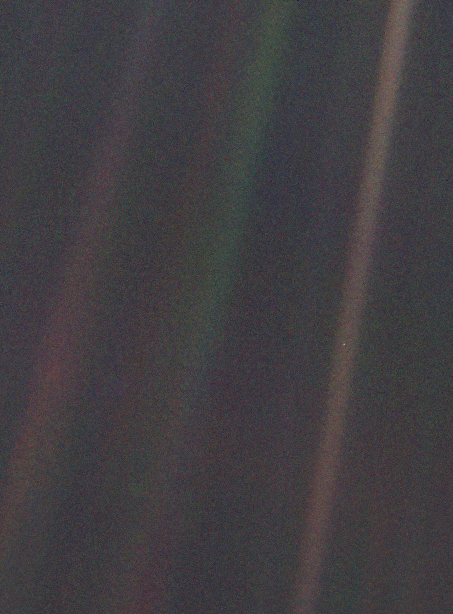
On 14 February 1990, six billion kilometres from home and on its way out of the solar system, the spacecraft Voyager 1 turned its cameras around and took a series of photographs looking back. In one of them the Earth appears as a single point of light, less than a pixel across, caught in a band of scattered sunlight. The image was named the Pale Blue Dot.
Voyager 1 had launched in 1977 and had already delivered close views of Jupiter and Saturn. Its cameras were no longer needed and were about to be shut down to save power. The astronomer Carl Sagan had argued for years that the spacecraft should take a family portrait of the planets before it went dark, an idea that had no scientific value in the usual sense and was resisted for exactly that reason. Permission was given at the end.
Sagan wrote about the result in a book published four years later, describing everyone who ever lived as having spent their lives on that mote of dust, and pointing out how much blood has been spilled by inhabitants of one corner of a dot in order to become the temporary masters of another corner. The passage has been quoted more often than any other piece of modern astronomy writing.
Voyager 1 crossed into interstellar space in 2012 and is still transmitting, the most distant human object in existence. The photograph it took on that February day carries no data of use to planetary science. It is a picture of the whole of human history, taken from far enough away to fit in a single point of light, and it has changed the way many people understand their own place.