The Lisbon Earthquake: All Saints Day, 1755
1755 · event
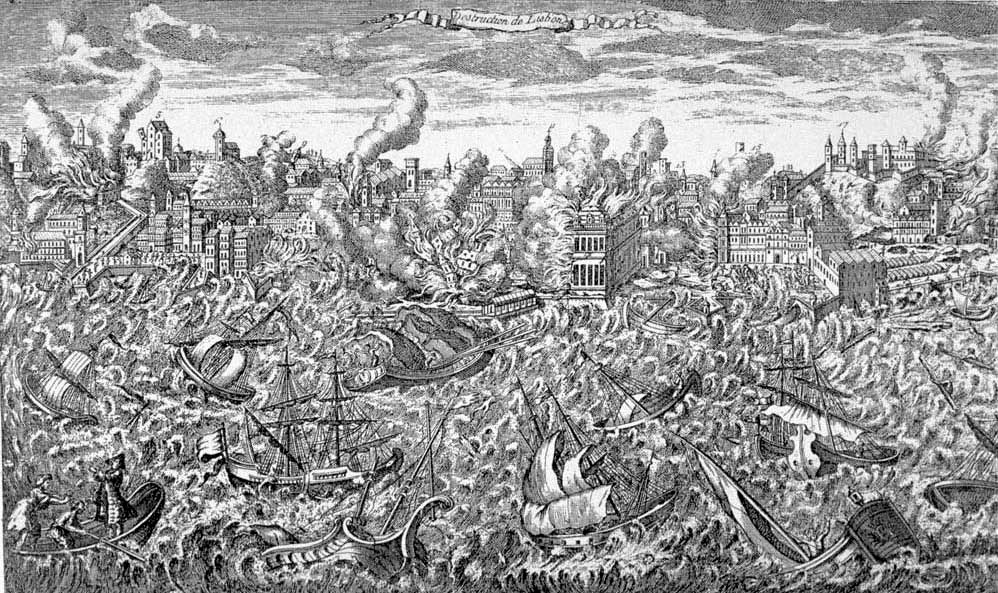
On the morning of 1 November 1755, as church bells called the faithful to Mass for the Feast of All Saints, a massive earthquake struck Lisbon. The tremor began at around half past nine, collapsing churches filled with worshippers, toppling palaces and humble homes alike. Within minutes, fires ignited across the shattered city. Then, roughly forty minutes after the first shock, the sea withdrew and returned as a towering tsunami, flooding the lower town and the crowded harbour where many had fled seeking safety from the flames and falling masonry.
Lisbon was then one of Europe's wealthiest capitals, heart of a global empire sustained by trade from Brazil, Africa and Asia. The earthquake's epicentre lay some two hundred kilometres west of Cape St. Vincent in the Atlantic. The destruction reached far beyond Portugal, shaking cities across the Iberian Peninsula and North Africa. In Lisbon alone, between thirty and forty thousand people perished. Another ten thousand died in Morocco. Countless buildings of immense cultural and historical value, including libraries, archives and works of art, vanished in the catastrophe.
In the aftermath, the Marquis of Pombal, King José I's chief minister, took swift control of recovery efforts. He organised relief, prevented looting and began rebuilding the city along new, rationally planned lines with earthquake-resistant structures. Pombal also distributed a detailed questionnaire to every parish in the country, gathering systematic observations about the disaster. This pioneering survey marked an early scientific approach to understanding earthquakes.
The Lisbon earthquake profoundly shook European thought. Philosophers including Voltaire and Kant questioned divine providence and the problem of suffering, influencing Enlightenment debates about reason, nature and human responsibility. The methodical investigation of the event laid the foundations for modern seismology and earthquake engineering, transforming how societies prepare for and respond to natural disasters. The memory endures as a turning point when humanity began to study catastrophe not with resignation but with science.