The First Message on ARPANET: 29 October 1969
1969 · event
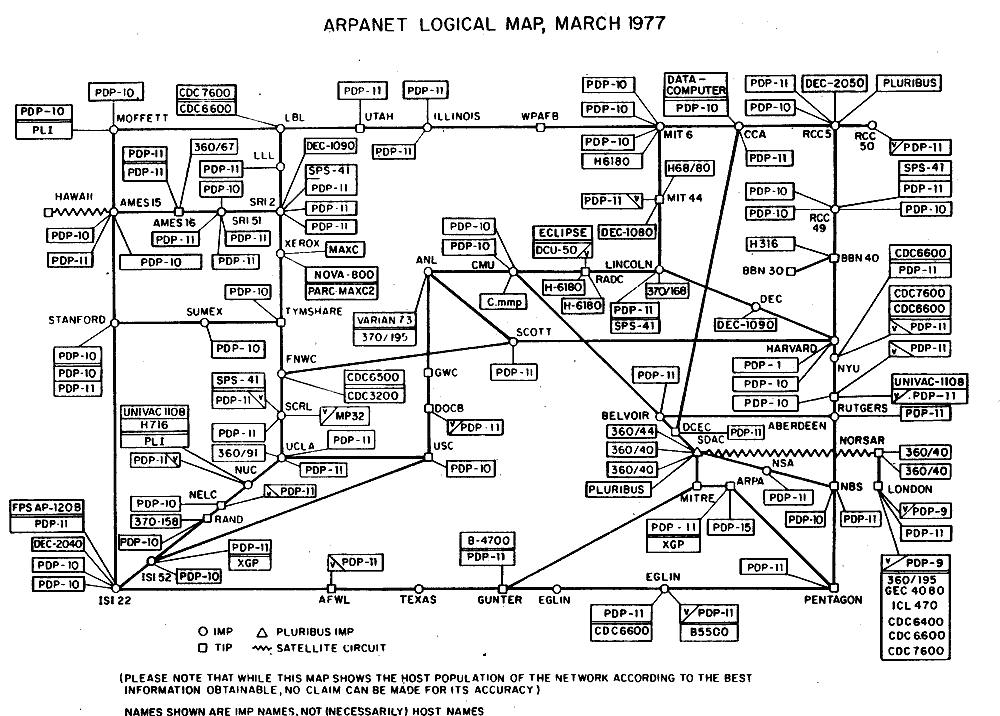
On 29 October 1969 a student at the University of California in Los Angeles sat at a terminal and began to type a word to a computer at a research institute near Stanford, four hundred kilometres away. Charley Kline was supervised by the engineer Leonard Kleinrock, and the plan was to log in remotely by typing login. He typed the L, then the O, confirming each letter by telephone with a colleague at the other end. The system crashed. The first message ever sent between two computers on the network was therefore the syllable lo, which nobody had planned and which sounds better than anything that could have been written for the occasion.
The network was called ARPANET and was funded by a research agency of the United States Department of Defense. Its purpose was to let expensive computers at different universities share work, and its design rested on packet switching, developed independently by Paul Baran in America and Donald Davies in Britain, in which messages are cut into small parcels that find their own way and are reassembled at the far end. The claim that it was built to survive a nuclear war is a simplification that has proved hard to remove.
An hour later the connection was restored and the login completed. By December there were four nodes, in Los Angeles, Stanford, Santa Barbara and Utah. Electronic mail appeared in 1971 and quickly became the main use, which nobody had predicted.
In 1983 the network adopted the protocols known as TCP and IP, which allow different networks to interconnect, and this is the moment usually taken as the birth of the internet proper. The equipment from that first night is preserved at UCLA, and the room where the two letters were typed is now a small museum.