Zaha Hadid
1950, 2016 · Iraq
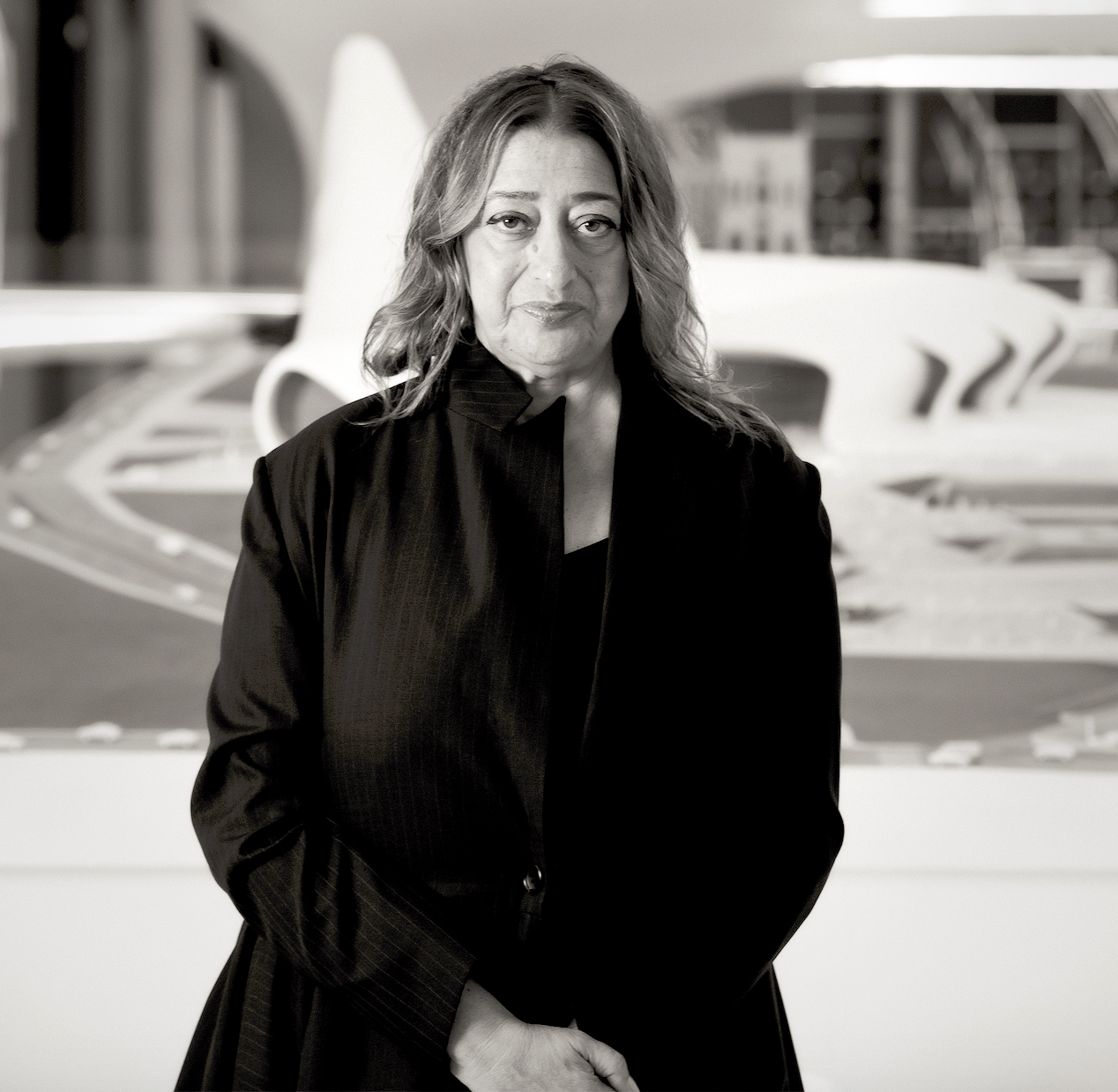
Known for: Architect who bent the straight line, and the first woman to win the Pritzker Prize
“The line she drew was never straight, and the world followed it.”
Biography
Zaha Hadid grew up in the Baghdad of the 1950s, in a household where politics and art were daily matter. Her father, Muhammad al-Hajj Husayn Hadid, was an industrialist from Mosul who helped found the National Democratic Party and later served as Iraq's minister of finance; her mother, Wajiha al-Sabunji, was an artist. Hadid traced her first pull towards architecture to childhood journeys to the ancient Sumerian cities of southern Iraq. She read mathematics at the American University of Beirut and in 1972 entered the Architectural Association School of Architecture in London, where her teachers included Rem Koolhaas and Elia Zenghelis. Her graduation project of 1977, Malevich's Tektonik, proposed a fourteen level hotel on Hungerford Bridge, presented not as a drawing but as an acrylic painting.
She worked in Rotterdam at the Office for Metropolitan Architecture, the practice of her former professors, and in 1980 opened Zaha Hadid Architects in London. For more than a decade her reputation rested on paintings and drawings rather than buildings. Influenced by Suprematism and the Russian avant garde, she used abstraction to reopen questions Modernism had left unfinished, and her radical schemes filled the journals but went unbuilt. The Peak in Hong Kong and an opera house for Cardiff were won and then lost, the Cardiff decision especially bitter because the jury had judged her design the best. The fire station she built for Vitra at Weil am Rhein between 1991 and 1993, in raw concrete and glass, proved the drawings could stand up. The curve became her signature: the MAXXI museum in Rome, the Guangzhou Opera House and the London Aquatics Centre for the 2012 Olympic Games.
Recognition came in a rush. Hadid was the first woman to receive the Pritzker Architecture Prize, in 2004, won the Stirling Prize in 2010 and again in 2011, was made a Dame by Elizabeth II in 2012 for services to architecture, and in February 2016 became the first woman awarded the Royal Gold Medal of the Royal Institute of British Architects in her own right. She never married and had no children, and teaching ran through her whole working life. She died in Miami on 31 March 2016, aged sixty five, of a heart attack suffered during treatment for bronchitis. Several of her buildings were still rising, among them Beijing Daxing International Airport. The geometry she argued for, angled, fluid, rarely at ninety degrees, had by then entered the ordinary vocabulary of architecture.