Věra Čáslavská
1942, 2016 · Czechia
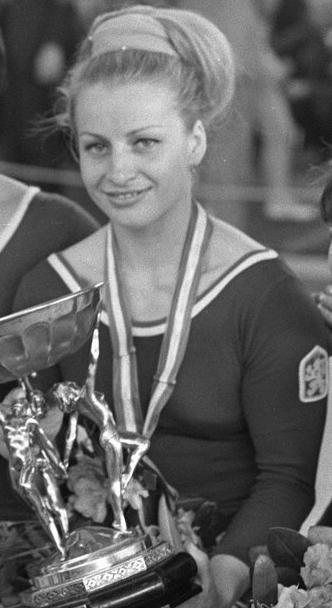
Known for: Olympic gymnast who won seven golds and protested in silence in 1968
“She gave her country perfection in sport and courage in silence.”
Biography
Věra Čáslavská was born in Prague on 3 May 1942 and came to gymnastics by a detour, having started out as a figure skater. She was sixteen when she first appeared at a world championship, in 1958, where the Czechoslovak team took silver, and a year later she won her first European title on the vault. From the Rome Olympics of 1960 she returned with a team silver medal, and at the world championships of 1962, held in her own city, she was held off in the all around only by Larisa Latynina of the Soviet Union, taking the world title on the vault instead. From then on she trained with the ambition of beating the Soviet school outright.
Between 1964 and 1968 Čáslavská won nineteen individual gold medals in major international competition and was never once beaten in the all around. At the Tokyo Olympics of 1964 she took the all around title along with gold on the beam and the vault; at the world championships of 1966 she won the all around, defended her vault title and led Czechoslovakia to a team gold that broke the Soviet monopoly. She swept all five individual European titles in 1965 and again in 1967, scoring two perfect tens along the way. In the summer of 1968 she signed the reform manifesto Two Thousand Words, and when Warsaw Pact troops entered the country she lost her training hall and went into hiding in the Jeseníky mountains, where she kept in condition with sacks of potatoes for weights and logs for a beam. Permission to travel to Mexico City came only at the last moment.
At those Games she won a medal in all six events, defending her all around title and adding gold on the vault, the uneven bars and the floor, the last of them shared after the judges revised a Soviet rival's score upward. Twice on the podium, at the beam and floor ceremonies, she lowered her head and turned it away while the Soviet anthem played. At home she was named sportsperson of the year, and then punished: pushed out of competition, refused work, and barred for years from travelling or even attending sporting events. Pressure from members of the International Olympic Committee eased her position in the 1980s, and after the Velvet Revolution she returned to public life, serving in the 1990s as president of the Czech Olympic Committee. She died on 30 August 2016, the most decorated gymnast her country has produced.