Václav Havel
1936, 2011 · Czechia
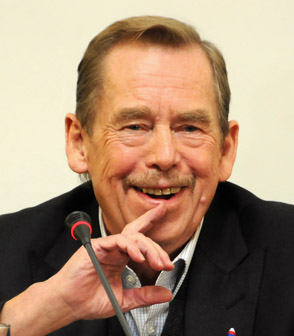
Known for: Playwright and dissident who led the Velvet Revolution and became president
“Truth and love must prevail over lies and hatred.”
Biography
Václav Havel was born in Prague on 5 October 1936 into a wealthy family known for its building enterprises and its patronage of Czech culture, an inheritance the communist state later counted against him. Barred by his class background from any faculty of the humanities, he trained as a chemical laboratory assistant, finished secondary school at evening classes in 1954, and spent two years studying economics at the Czech Technical University before giving it up. After military service he took work as a stagehand at the Theatre on the Balustrade in Prague, studied drama by correspondence at the theatre academy, and in 1964 married Olga Šplíchalová.
His first full length play, The Garden Party, reached the stage in 1963 and made his name abroad; The Memorandum followed. Both used the devices of absurdist theatre to expose the language and the logic of a bureaucratic dictatorship. During the Warsaw Pact invasion of August 1968 he broadcast over Radio Free Czechoslovakia from Liberec, and in the years of enforced normalisation his plays were banned at home. He worked for a time in a brewery in Trutnov, an experience he turned into the play Audience, and circulated his writing in samizdat. In 1977 he became one of the founders and spokesmen of Charter 77, the manifesto that gathered citizens around the human rights their government had signed and ignored, and in 1979 he helped establish the Committee for the Defense of the Unjustly Prosecuted. The secret police watched him constantly, and he was imprisoned several times, the longest term lasting nearly four years, from 1979 to 1983.
When the Velvet Revolution broke out in November 1989, Havel led Civic Forum through the negotiations that ended communist rule without bloodshed, and in December he was elected president of Czechoslovakia. He was the last to hold that office, and after the state divided he served as the first president of the Czech Republic from 1993 to 2003, working to dissolve the Warsaw Pact and to bring his country into NATO. Some of his decisions, among them a general amnesty for prisoners of the communist era and his objections to Slovak independence, were argued over bitterly at home even as his standing rose abroad. Out of office he kept writing and convening, through the Forum 2000 conferences and the VIZE 97 foundation, until his death at his country house in Hrádeček on 18 December 2011. In 2012 the international airport in Prague was renamed after him.