Johannes Kepler
1571, 1630
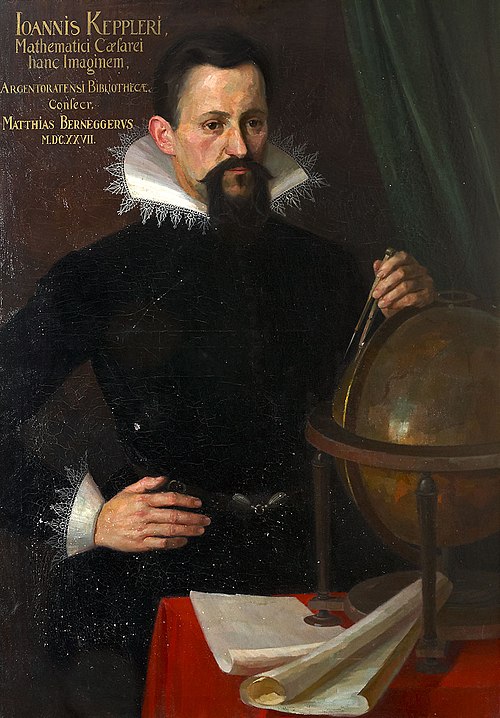
Known for: Laws of planetary motion
“He revealed the hidden geometry of the celestial spheres”
Biography
Johannes Kepler was a German polymath whose restless mind sought to understand the mechanisms of the cosmos itself. Born into a turbulent era of religious conflict and scientific upheaval, he became an astronomer, mathematician, astrologer, and natural philosopher whose curiosity seemed boundless. His masterwork, Astronomia nova, revolutionized how humanity conceived of planetary motion, moving beyond the static perfection of circles to embrace the dynamic reality of ellipses. Through painstaking observation and mathematical reasoning, Kepler discovered the laws governing how planets orbit the sun, transforming astronomy from descriptive cataloguing into predictive science.
Kepler's intellectual legacy extended far beyond the heavens. His books, including Harmonice Mundi and Epitome Astronomiae Copernicanae, wove together mathematics, music, and natural philosophy into a unified vision of cosmic harmony. He was not merely an observer but a builder of method itself, helping to establish the systematic approach that would define modern science. During the turbulent seventeenth century, when superstition and reason often clashed violently, Kepler stood as a figure of profound intellectual courage, demonstrating that through patient investigation and bold hypothesis, the universe's deepest secrets could be illuminated.