Isaac Newton
1643, 1727 · England
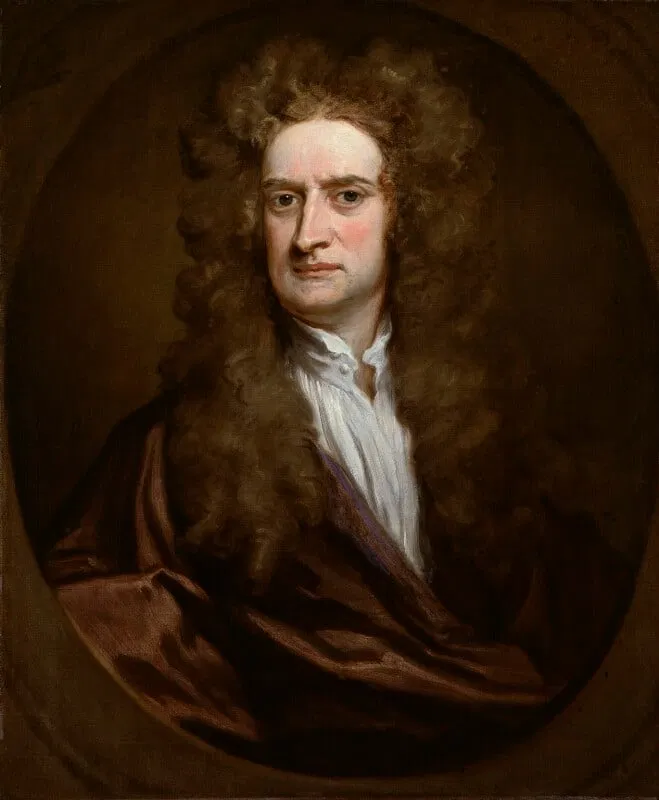
Known for: Laws of Motion, Universal Gravitation, Calculus, Optics
“Nature and nature's laws lay hid in night; God said "Let Newton be" and all was light”
Biography
Sir Isaac Newton was an English mathematician, physicist, astronomer, alchemist, theologian, and author who is widely recognised as one of the greatest mathematicians and physicists of all time. Born in Woolsthorpe, Lincolnshire, Newton developed the principles of modern physics, including the laws of motion, and is credited with developing calculus independently of Gottfried Wilhelm Leibniz. His work "Philosophiæ Naturalis Principia Mathematica" (Mathematical Principles of Natural Philosophy), first published in 1687, laid the foundations for classical mechanics. Newton also made seminal contributions to optics and shares credit with Leibniz for developing infinitesimal calculus. His discovery of the law of universal gravitation revolutionized our understanding of the cosmos. Newton was also deeply interested in alchemy, biblical chronology, and theology, though he kept many of his religious views private. He served as Warden and Master of the Royal Mint, was elected a Fellow of the Royal Society, and was knighted by Queen Anne in 1705. His influence on the scientific revolution cannot be overstated, and his methods of scientific inquiry became the gold standard for centuries to come.