Hannah Arendt
1906, 1975 · Germany
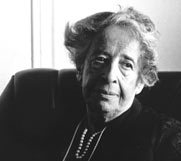
Known for: Political theorist of totalitarianism, statelessness and the banality of evil
“Nothing more than to think what we are doing.”
Biography
Hannah Arendt was born Johanna Arendt on 14 October 1906 in Linden, near Hanover, into a secular and politically progressive Jewish family with deep roots in Königsberg, where she grew up. Her father, an engineer who took more pride in his classical library than in his profession, died when she was seven, and her mother, a musician and a convinced Social Democrat, raised her alone. The library stayed. After school in Berlin she went to Marburg to study under Martin Heidegger, with whom she had a love affair that began while she was his student, and then to Heidelberg, where she took her doctorate in philosophy in 1929 with a dissertation on the concept of love in Augustine, supervised by Karl Jaspers.
In 1933 the Gestapo held her briefly for gathering evidence of antisemitic propaganda. On her release she left Germany for Paris, where she worked for Youth Aliyah, helping young Jews to reach Palestine. Interned by the French authorities as an enemy alien, she got out and reached the United States in 1941, worked as a writer and editor, and became an American citizen in 1950. The Origins of Totalitarianism, published in 1951, traced the ground from which Nazi and Soviet rule had grown, and gave particular weight to the modern condition of statelessness, of people who have lost not this right or that but the right to have rights at all. The Human Condition followed in 1958. In 1961 she covered the trial of Adolf Eichmann in Jerusalem; the book she made of it in 1963, and the phrase in its subtitle, the banality of evil, brought her a controversy that outlived her.
Arendt taught at Berkeley, Princeton, Chicago and the New School in New York, declining tenured appointments and refusing the title of philosopher: she called herself a political theorist. On Revolution appeared in 1963 and further essays and lectures followed, on authority, on freedom, on lying in politics. She died of a heart attack in New York on 4 December 1975, at sixty nine. The last part of The Life of the Mind was never written; a sheet in her typewriter carried only its title, Judging. What she left is a body of thought that keeps its usefulness because it was never a system, only the habit of looking at what is actually there.