Galileo Galilei
1564, 1642 · Italy
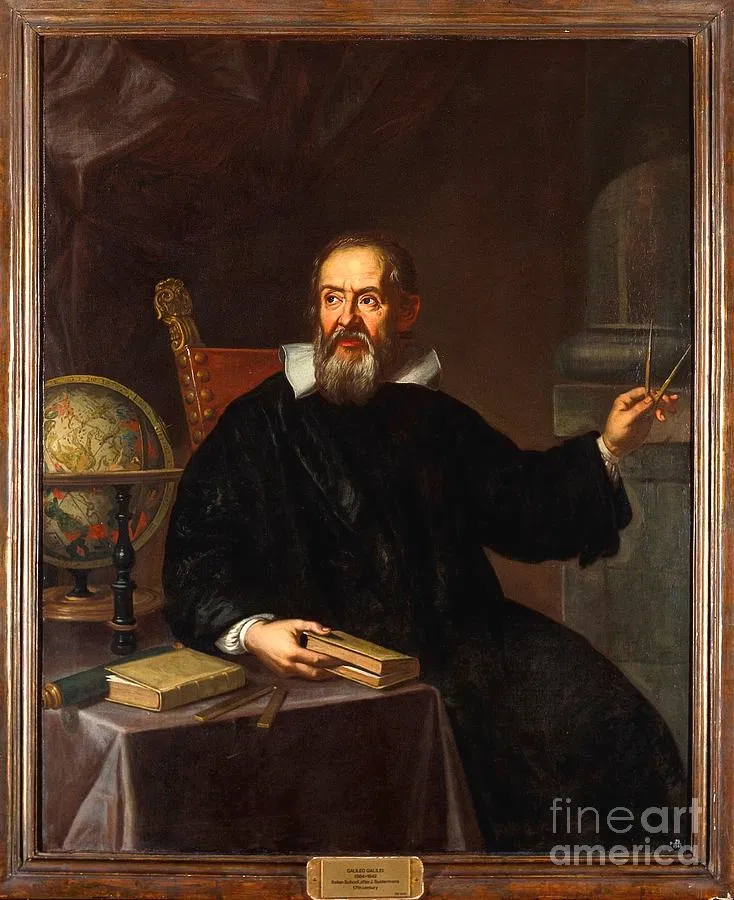
Known for: Telescope improvements, Astronomical observations, Father of modern science, Heliocentrism
“E pur si muove (And yet it moves) - Alleged words after recanting heliocentrism”
Biography
Galileo di Vincenzo Bonaiuti de' Galilei was an Italian astronomer, physicist, and engineer, often described as a polymath and called the "father of observational astronomy," "father of modern physics," "father of the scientific method," and "father of modern science." Born in Pisa, Galileo initially studied medicine before turning to mathematics and natural philosophy. His improvements to the telescope revolutionized astronomy, allowing him to make groundbreaking observations including the moons of Jupiter (now called the Galilean moons: Io, Europa, Ganymede, and Callisto), the phases of Venus, sunspots, and the detailed topography of the Moon. These discoveries provided crucial evidence for the Copernican heliocentric model of the solar system, which placed the Sun, rather than Earth, at the center. Galileo's support for heliocentrism brought him into conflict with the Catholic Church, which held to the geocentric Ptolemaic system. In 1633, he was tried by the Roman Inquisition, found "vehemently suspect of heresy," and forced to recant. He spent the rest of his life under house arrest. Despite this persecution, Galileo continued his scientific work, publishing "Two New Sciences" (1638), which laid the groundwork for classical mechanics. His experiments with falling bodies, pendulums, and projectile motion challenged Aristotelian physics and established the principle that all objects fall at the same rate regardless of mass. Galileo's insistence on mathematical description of nature and experimental verification established the scientific method that remains the foundation of modern science. In 1992, more than 350 years after his trial, Pope John Paul II acknowledged the Church's error in condemning Galileo.