Franz Schubert
1797, 1828 · Austria
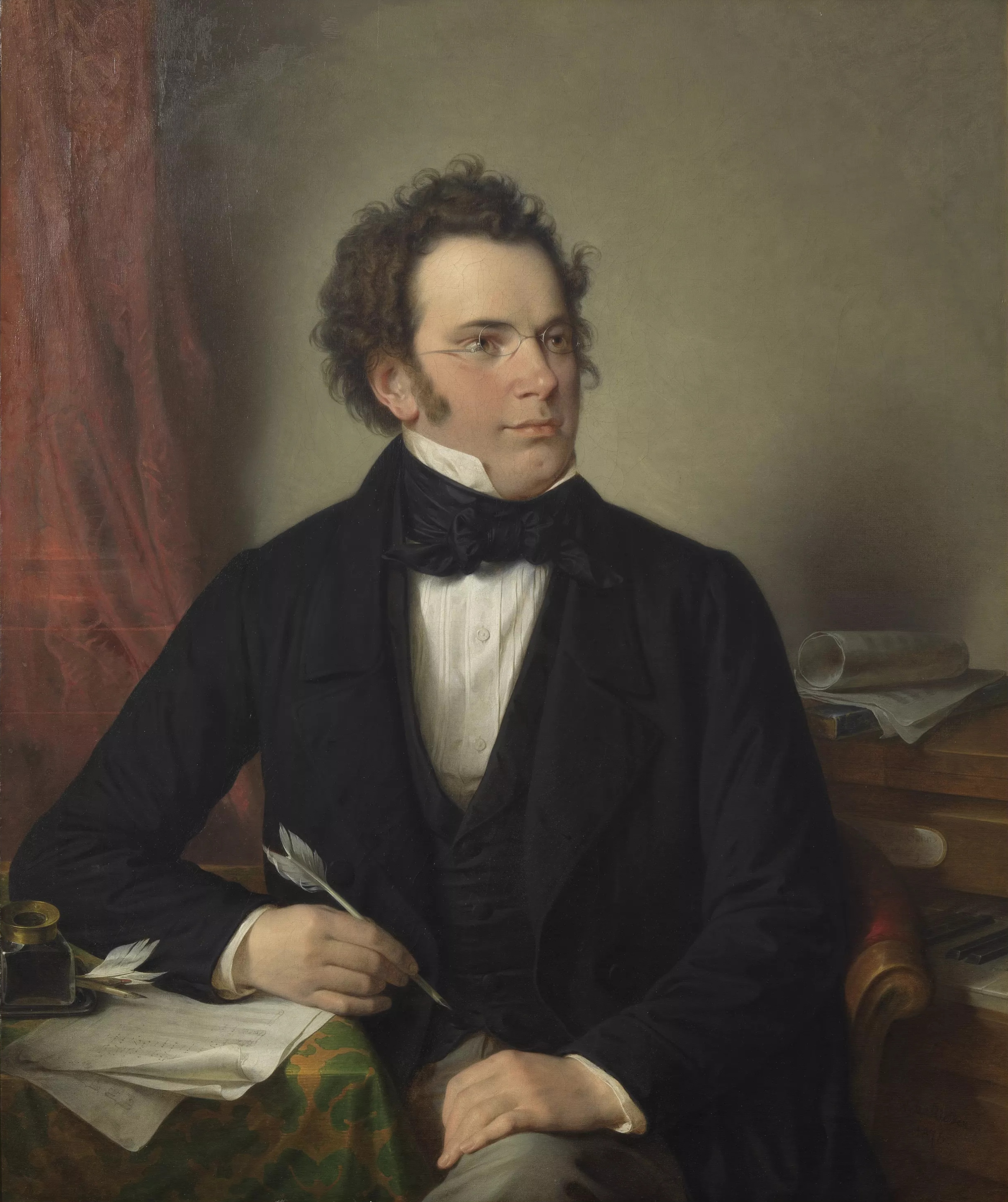
Known for: Austrian composer of the Lied, who wrote over six hundred songs before his death at thirty-one
“Here music has buried a treasure, but even fairer hopes.”
Biography
Franz Schubert was born on 31 January 1797 in Himmelpfortgrund, a suburb of Vienna, the twelfth of fourteen children of a parish schoolmaster and his wife, the daughter of a Silesian locksmith; only five of the children reached adulthood. His father taught him the violin and his brother Ignaz the piano, and the boy outran both within months, taking further lessons in organ, singing and figured bass from Michael Holzer, choirmaster of the parish church in Lichtental. A choir scholarship carried him in 1808 into the Stadtkonvikt, the imperial seminary, where he met the symphonies of Haydn and Mozart and the early works of Beethoven, whom he admired above all others. He left at the end of 1813, trained as an assistant in his father's school, and went on studying composition privately with Antonio Salieri.
He composed at a speed that still astonishes: more than a thousand works in some eighteen years, among them over six hundred songs, seven symphonies, operas, sacred music and much chamber and piano music. At seventeen he set Goethe's Gretchen am Spinnrade, and Erlkönig followed soon after; both showed that a song could carry the weight of drama and that the piano was no longer an accompaniment but a second voice. The two great cycles, Die schöne Müllerin and Winterreise, turned a sequence of poems into one sustained journey. In instrumental music he left the Trout Quintet, the String Quartet in D minor known as Death and the Maiden, the String Quintet in C major, the Impromptus and the two symphonies posterity calls the Unfinished and the Great. Much of it was first heard not in concert halls but at private evenings among friends, the gatherings later known as Schubertiaden.
Recognition came slowly and stayed largely within Vienna. In 1821 he was admitted as a performing member of the Gesellschaft der Musikfreunde, and in March 1828 he gave the only concert of his career devoted entirely to his own works, to warm acclaim. Eight months later, on 19 November 1828, he died in Vienna at the age of thirty-one; the official cause was typhoid fever, though some historians have argued for syphilis. He was buried near Beethoven, and the words cut into his stone were written by the poet Franz Grillparzer. In the decades that followed, Mendelssohn, Schumann, Liszt and Brahms sought out his manuscripts and carried them into the world, and music that had circulated among a few friends became part of the permanent repertoire.