Dmitri Mendeleev
1834, 1907 · Russia
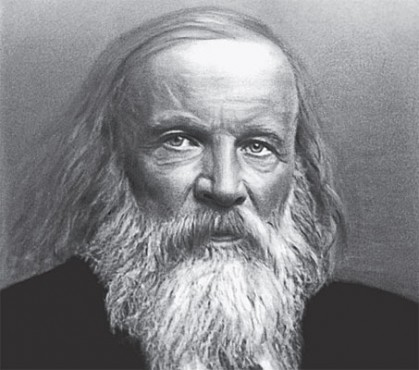
Known for: Russian chemist who formulated the periodic law and created the periodic table of the elements
“He set the elements in order and left space for those not yet discovered.”
Biography
Dmitri Ivanovich Mendeleev was born on 8 February 1834 in Verkhnie Aremzyani, a village near Tobolsk in Siberia, the youngest child of a very large family. His father taught and directed a gymnasium until blindness cost him the post; his mother, from a family of Tobolsk merchants who had founded the first printing house in Siberia, reopened an abandoned glass factory to support the household. When Mendeleev was thirteen his father died and the factory burned. In 1849 his mother took him across the empire to Moscow, where the university refused him, and on to Saint Petersburg, where he entered the Main Pedagogical Institute in 1850. Tuberculosis sent him to the Crimea in 1855 to teach school science, and he returned to the capital in 1857 with his health restored.
Between 1859 and 1861 he worked in Heidelberg on the capillarity of liquids and on the spectroscope, and in 1861 published a textbook of organic chemistry that won him the Demidov Prize. Professorships at the Saint Petersburg Technological Institute and at the university followed in 1864 and 1865, and by 1871 he had made the city a recognised centre of chemical research. While preparing his lecture course he wrote Principles of Chemistry, issued in two volumes between 1868 and 1870, and it was in arranging the elements for that book that he found his pattern. On 6 March 1869 he presented it to the Russian Chemical Society: ordered by atomic weight, the elements show a periodicity of properties. He left gaps rather than force the table to close, and predicted the weights and properties of three elements still unknown; gallium, scandium and germanium were duly found. He also corrected the accepted atomic weight and valence of uranium.
Others had glimpsed periodicity before him, among them John Newlands and Lothar Meyer, but Mendeleev's table was the one that made testable predictions. In later years he directed the Russian bureau of weights and measures and wrote widely beyond the laboratory, on the oil industry and on agriculture. He was nominated for the Nobel Prize in Chemistry without receiving it, and died in Saint Petersburg on 2 February 1907. Element 101, mendelevium, was named in his honour. The table itself, much revised but recognisably his, is still among the first things a student of chemistry learns.