Alexander Pushkin
1799, 1837 · Russia
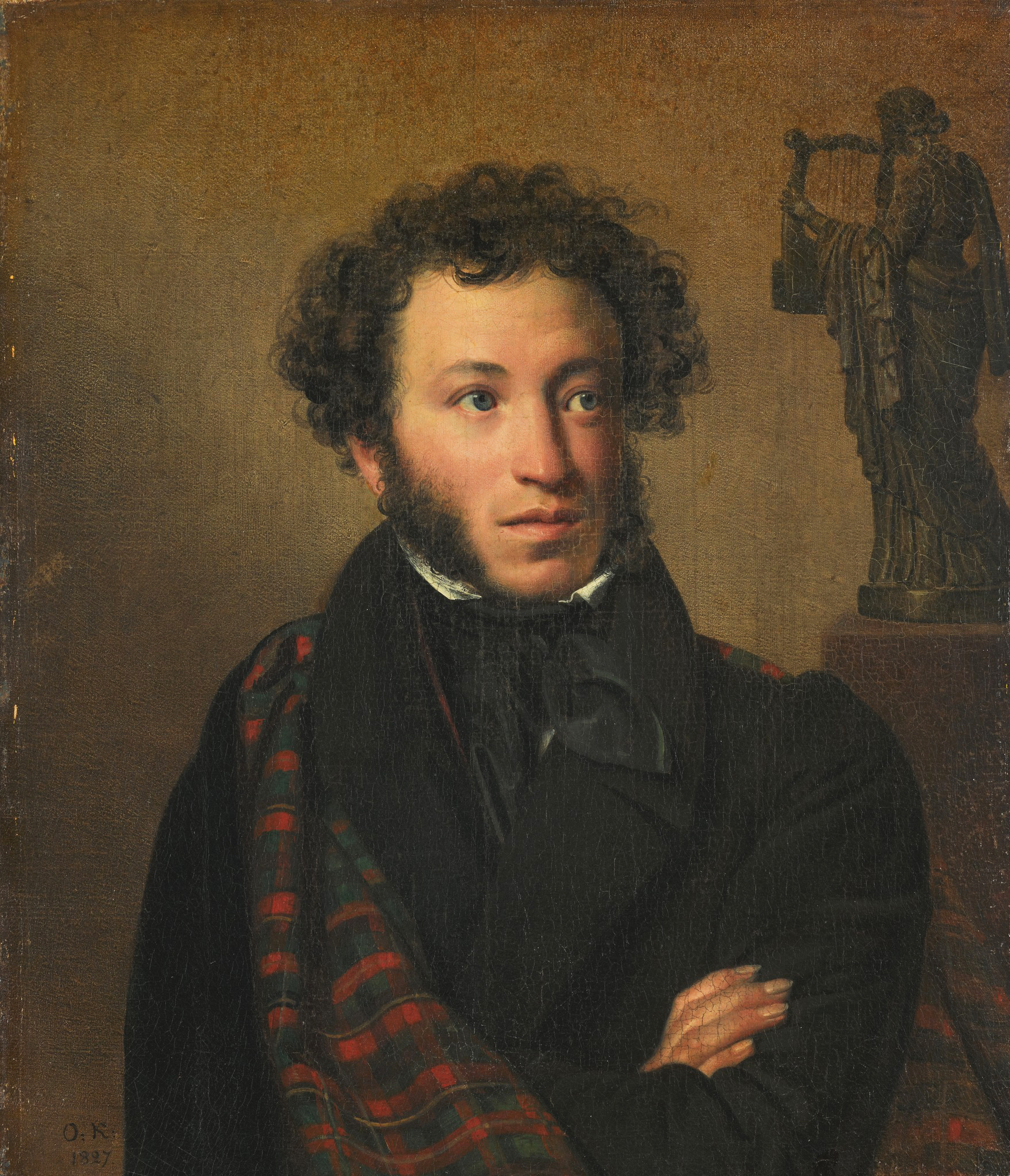
Known for: Founder of modern Russian literature and its greatest poet
“I have raised myself a monument not built by hands.”
Biography
Alexander Pushkin was born in Moscow on 26 May 1799 into an old family of the Russian nobility. His mother's grandfather was Abram Gannibal, an African child taken to Constantinople and given to the Russian court, where Peter the Great freed him, stood as his godfather and had him raised to become a general and military engineer; Pushkin was proud of that descent and returned to it in his writing. Brought up by French tutors, he spoke French before he spoke good Russian, and it was from the household serfs and above all from his nanny, Arina Rodionovna, whose tales he loved, that he came to the language he would remake. He published his first poem at fifteen, and by the time he left the first graduating class of the Imperial Lyceum at Tsarskoye Selo his gift was known across literary Petersburg.
Fame arrived with the narrative poem Ruslan and Ludmila in 1820, and trouble arrived with it. Verses such as the Ode to Liberty made him a spokesman for reform, and that spring the government removed him from the capital: first to the Caucasus and Crimea, then to Bessarabia and Odessa, and finally to his mother's estate at Mikhailovskoye, where he lived under surveillance from 1824 to 1826. Exile proved productive. He wrote The Prisoner of the Caucasus and The Fountain of Bakhchisaray, and at Mikhailovskoye in 1825 the drama Boris Godunov, which he was not permitted to publish for five years. Above all he worked at Eugene Onegin, the novel in verse serialised between 1825 and 1832, whose stanza and whose plain, exact Russian gave the country a modern literature of its own.
Nicholas I released him from exile and appointed himself his censor. Pushkin married Natalya Goncharova in 1831 and returned to Petersburg, where court life, debt and gossip pressed upon him. Anonymous letters mocking his marriage led him to challenge Georges d'Anthès, a French officer of the Chevalier Guard who had courted his wife and married her sister. They met on 27 January 1837 beside the Black River outside the capital. Pushkin was shot through the abdomen and died two days later, on 29 January, aged thirty seven. Crowds filled the street outside his flat, and the uneasy authorities moved the funeral and had him buried quietly near Mikhailovskoye. His work founded the language of Russian literature, and Gogol, Turgenev, Dostoyevsky and Tolstoy all wrote in the space he had opened.