Albert Einstein
1879, 1955 · Germany
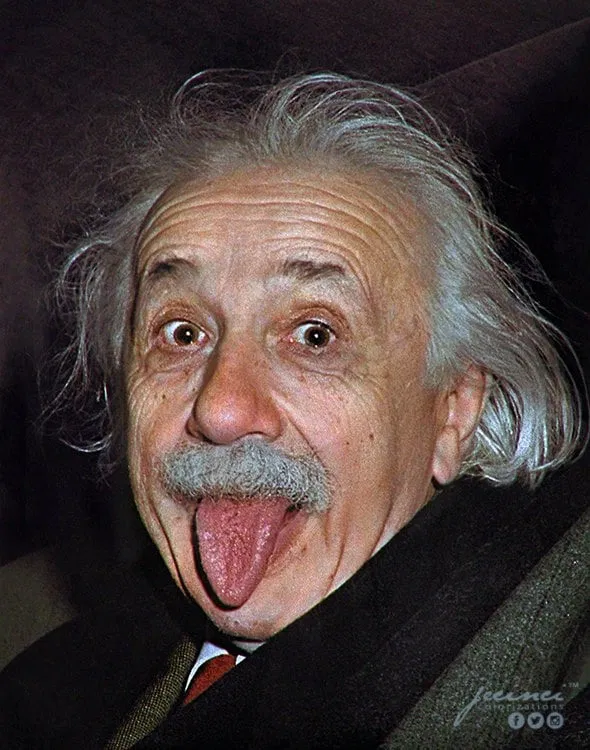
Known for: Theory of Relativity, E=mc², Nobel Prize in Physics
“Imagination is more important than knowledge”
Biography
Albert Einstein emerged from Ulm, Germany, in 1879 into a world of industrial transformation, yet his greatest revolutions would occur not in factories but in the realm of thought. After a restless education and years of modest employment, he found himself in 1905-his annus mirabilis-publishing four revolutionary papers while working as a technical examiner in Bern. Among these lay the seeds of special relativity and the elegant equation E=mc², which would forever bind energy and matter in the human imagination. His wild hair and rumpled appearance became the visual signature of genius itself, though the man beneath harbored a deep philosophical curiosity that transcended mere equations.
By mid-life, Einstein had reshaped our understanding of gravity, space, and time through general relativity, earning him recognition across continents. His 1921 Nobel Prize in Physics crowned a career of extraordinary achievement, though the award itself acknowledged only the photoelectric effect, a more conventional discovery. Fleeing Nazi Germany in 1933, he carried his moral conscience alongside his scientific legacy to America, becoming an elder statesman of physics. In his final decades, this once-patent clerk became humanity's philosopher of the cosmos, reminding us that imagination was more important than knowledge-a principle he lived with undiminished wonder until his death in 1955.